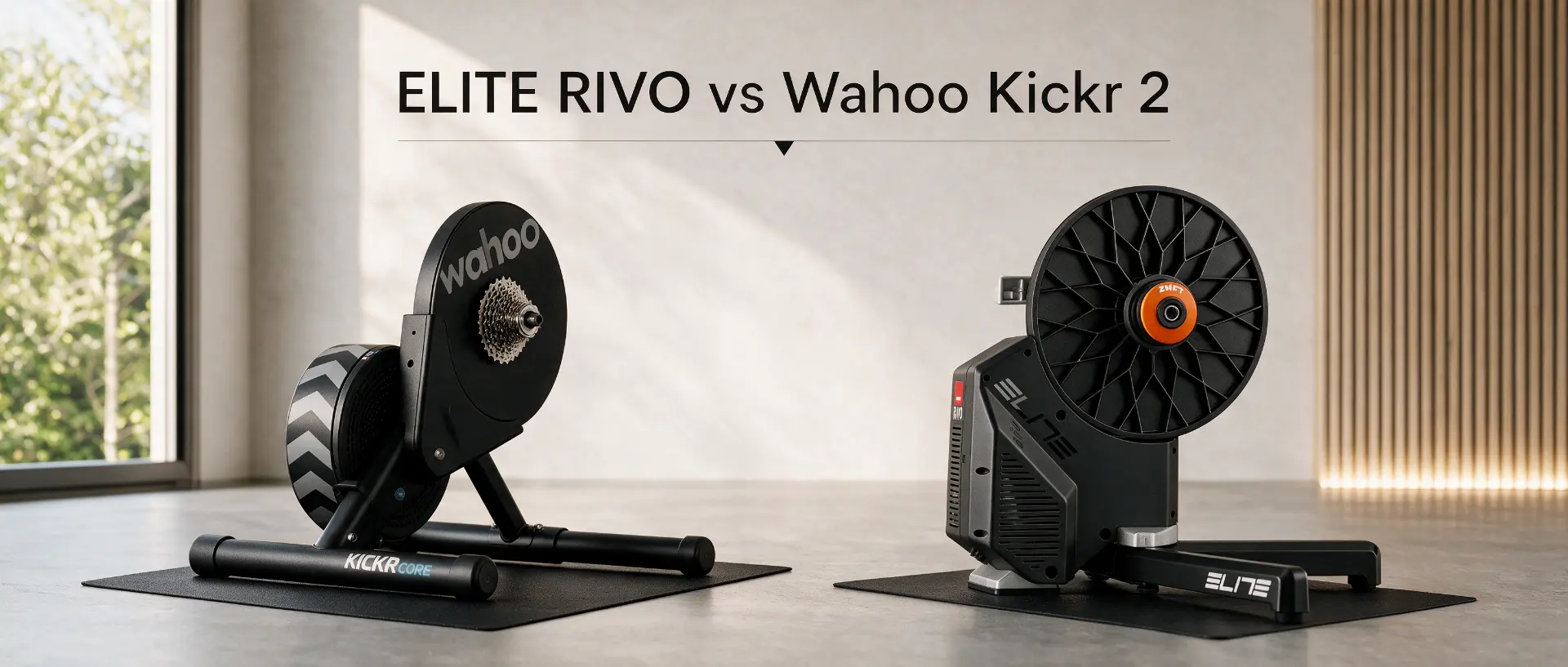
Wahoo Kickr Core 2 vs Elite Rivo: UK 2026 Comparison Review
Last updated: October 2026
Availability update (October 2026): Madison, Elite's UK distributor, has stopped selling the Rivo, so it's no longer available new through UK bike shops, including us. You may still find leftover stock or a second-hand one. We've kept this comparison up because the differences still matter if you're weighing up a used Rivo or already own one. If you're buying new, jump to If you wanted the Rivo: what to buy instead.
The Verdict, Up Front
The Wahoo Kickr Core 2 with Zwift Cog (£464.99) and the Elite Rivo with Zwift Cog & Click were two of the closest-matched mid-range direct-drive trainers on the UK market, both Zwift Ready out of the box, both with Wi-Fi, and both with an RRP of £499.99. For most UK riders, the Kickr Core 2 is the better buy: its heavier 5.4kg flywheel gives a noticeably smoother, more road-like ride, its power data is more dependable, and it keeps ANT+, Race Mode, and automatic calibration, all of which the Rivo lacks. The Rivo's strength is space: at 10kg with folding legs and a proper carry handle, it's by far the easier trainer to stow away between sessions, and it simulates steeper gradients on paper (18% vs 16%). With the Rivo no longer sold new in the UK, the Core 2 is also the only one of the two you can reliably buy today.
At a Glance Comparison
| Spec | Wahoo Kickr Core 2 (Zwift Cog) | Elite Rivo (Zwift Cog & Click) |
|---|---|---|
| Price | £464.99 (RRP £499.99) | No longer sold new in the UK (RRP was £499.99) |
| Type | Direct-drive smart trainer | Direct-drive smart trainer |
| Power accuracy | ±2% | ±2.5% (estimated power) |
| Max power | 1,800 watts | 2,000 watts (at 40km/h) |
| Max simulated gradient | 16% | 18% |
| Connectivity | Wi-Fi, Bluetooth, ANT+, ANT+ FE-C | Wi-Fi, dual-channel Bluetooth (no ANT+) |
| Race Mode (10Hz data) | Yes, Wi-Fi and Bluetooth (Zwift) | No |
| Auto-calibration | Yes | No, manual spin-down |
| Zwift Cog & Click | Pre-installed | Pre-installed |
| Flywheel | 5.4kg | 3.5kg |
| Weight | 13.6kg | 10kg |
| Folding legs / handle | No / no | Yes / yes |
| Max rider weight | 113kg | 110kg |
Price & Value
Kickr Core 2: £464.99 (RRP £499.99) with the Zwift Cog and Click included, or £499.99 with an 11-speed cassette pre-installed if you'd rather skip virtual shifting.
Elite Rivo: RRP £499.99 with the Zwift Cog and Click 2 pre-installed, and it came with a Zwift subscription promotion and a 12-month My E-Training subscription in the box. It's no longer sold new in the UK, so if you're looking at a used one, check whether any subscription codes have already been redeemed.
At the same RRP, the Rivo's on-paper advantages were steeper gradient simulation and a higher max power figure. But the spec sheet flatters it. For the same money the Kickr Core 2 buys a flywheel that's over 50% heavier, ANT+ alongside Bluetooth and Wi-Fi, Race Mode, and auto-calibration. That's a lot of extra practical capability.
Power Accuracy
Kickr Core 2: ±2% claimed. In independent testing (DC Rainmaker logged over 1,000km across two separate units), it tracked within roughly 1.5–2% of reference power meters across steady-state riding, ERG workouts, and sprints. It also self-calibrates continuously, so accuracy holds without any user intervention.
Elite Rivo: ±2.5% claimed. The Rivo doesn't have an integrated power meter — it estimates power from internal algorithms, like most trainers at this price. In BikeRadar's testing it was broadly on target at steady wattages, but frequently under-reported sprints and showed some drift within rides. There's no auto-calibration, so you're reliant on manual spin-downs — which, on Zwift, can only be done when connected via Wi-Fi.
What it means in practice: For everyday training and Zwift group rides, both are accurate enough. But the Kickr Core 2 is the more trustworthy of the two — particularly if you sprint, race, or follow structured workouts where drifting numbers undermine the session. If you already own a Bluetooth power meter, you can bridge it through the Rivo and sidestep the issue entirely.
Ride Feel
This is the biggest real-world difference between the two.
Kickr Core 2: The 5.4kg flywheel is one of the best in the sub-£500 class, delivering a smooth, weighted pedal stroke that carries momentum realistically through the dead spots. At 13.6kg with wide-set legs, it stays planted during out-of-saddle sprints.
Elite Rivo: The 3.5kg flywheel is the compromise you make for the Rivo's low weight. Reviewers consistently describe the ride as choppier and less fluid than the Kickr Core 2, with inertia dropping off quickly when you ease off the pedals. The jumps between virtual gears also feel slightly more stark at the harder end of the range. And at just 10kg overall, the trainer can shuffle around beneath you in hard sprints.
What it means in practice: If you ride daily and leave the trainer set up, the Kickr Core 2 simply feels better under your feet, every session. If the trainer lives in a cupboard between rides, the Rivo's portability may be worth the trade.
Noise
Kickr Core 2: Quiet. The dominant sound is your drivetrain rather than the trainer — and with the Zwift Cog's adjustable indexing and silent virtual shifting, even that is minimised.
Elite Rivo: Also quiet — measured at around 60–62 decibels at 150 watts, rising to 65–66 decibels in sprints. Perfectly acceptable for flats and shared houses.
What it means in practice: Nothing separates them once a fan is running. Neither will annoy the neighbours; your drivetrain and breathing will be louder than either trainer. If noise is your main concern, see our guide to the quietest smart trainers for flats and apartments.
Setup & Daily Use
Kickr Core 2: Colour-coded legs, an Allen key, and about ten minutes from box to first ride. The Zwift Cog and Click come pre-installed, Wi-Fi pairing through the Wahoo app is straightforward, and firmware updates download automatically. Status LEDs show connection state at a glance, and calibration is fully automatic.
Elite Rivo: Assembly is similarly simple — three legs and an Allen key — though the legs aren't colour-coded and the axle adaptors come unlabelled in a bag, so beginners may need the instructions to hand. Wi-Fi setup runs through Elite's My E-Training app, but firmware updates require a second app (Upgrado). One genuine quirk to know about: virtual shifting only works over Bluetooth on the Rivo, so if you connect via Wi-Fi (which Zwift actively recommends on its pairing screen), the Zwift Cog leaves you with no gears at all until you switch connection type. Zwift remembers your choice afterwards, but it's a confusing first-ride trap.
What it means in practice: Both are easy trainers to live with, but the Kickr Core 2 has fewer gotchas. On the Rivo you need to remember: Bluetooth for virtual shifting, Wi-Fi for spin-down calibration. On the Core 2, everything works over everything.
App Compatibility
Both work with all major training apps — Zwift, TrainerRoad, Wahoo SYSTM, Rouvy, MyWhoosh, Kinomap and more — though with either trainer, the Zwift Cog's virtual shifting is only supported in Zwift and Rouvy. Fit a standard cassette (both freehubs take Shimano/SRAM 9–12 speed) and every app works normally.
Kickr Core 2 advantages: ANT+ and ANT+ FE-C alongside Bluetooth and Wi-Fi, so it pairs with any bike computer or older device without fuss. Race Mode broadcasts power at 10Hz over Wi-Fi or Bluetooth for e-racing.
Elite Rivo advantages: Dual-channel Bluetooth plus sensor bridging lets you pipe a heart rate monitor or cadence sensor through the trainer's single connection — genuinely useful on Apple TV with its two-sensor limit (the Core 2 offers bridging too). The Rivo also plugs into Elite's wider ecosystem: the Rizer gradient simulator, the Square smart frame, and the Aria smart fan. And uniquely, it can run unplugged in a stand-alone mode with a pre-set resistance level — handy for warm-ups at races.
What it means in practice: No ANT+ on the Rivo won't bother most Zwift-first riders, but if you record rides on an older Garmin or use ANT+ accessories, it's a real limitation. The Core 2 is the safer all-round connectivity package.
Portability & Storage
Kickr Core 2: At 13.6kg it's lighter than the original Core, but its fixed wide legs mean it occupies the same footprint whether you're riding or not. No handle.
Elite Rivo: This is where the Rivo shines. It weighs just 10kg, the legs fold flat against the body (52 × 16 × 49cm closed), and there's a proper integrated handle. It's the easiest direct-drive trainer at this price to carry upstairs, slide under a bed, or throw in a car boot.
What it means in practice: If your trainer lives permanently in a pain cave, this section doesn't matter. If it has to disappear into a cupboard after every session — or travel to races — the Rivo is in a class of its own here.
Use Case Comparison
| Your situation | Better choice |
|---|---|
| You ride mostly Zwift and want the best ride feel | Kickr Core 2 |
| Space is tight and the trainer must pack away after each ride | Elite Rivo (now only available used or as leftover stock in the UK) |
| You race indoors and want Race Mode + dependable sprint data | Kickr Core 2 |
| You use ANT+ devices (older Garmin, etc.) | Kickr Core 2 |
| You're an Apple TV user | Either, both bridge sensors |
| You want the Elite Rizer or Square smart frame later | Elite Rivo (discontinued in the UK), or another Elite trainer such as the Avanti |
| You want set-and-forget calibration | Kickr Core 2 |
| You travel to races and want a warm-up trainer | Elite Rivo (unpowered mode, discontinued in the UK) |
| You want to buy new, today, under £500 | Kickr Core 2 |
Where Each Falls Short
Wahoo Kickr Core 2 weaknesses
- No folding legs or carry handle, so it's the bulkier trainer to store
- 16% max gradient trails the Rivo's 18% on paper
- Underlying resistance hardware is an evolution of a 2018 design
- Heavier than the Rivo (13.6kg vs 10kg)
Elite Rivo weaknesses
- No longer sold new in the UK
- 3.5kg flywheel gives a noticeably choppier, less realistic ride feel
- Power estimation can under-report sprints and drift mid-ride
- No ANT+, no Race Mode, no auto-calibration
- Virtual shifting works over Bluetooth only; Zwift spin-downs over Wi-Fi only
- Firmware updates need a separate app
Long-Term Ownership
Both brands are long-established. Wahoo has the larger UK service network and a strong record of supporting older trainers with firmware updates. Elite, founded in 1979 and manufacturing in Italy, is equally reputable, and the Rivo scores points for repairability and sustainability, with 22% of its plastics from pre-consumer recycled material and a design intended for easy maintenance.
If you already own a Rivo or are buying one second-hand, the trainer itself is unaffected by the UK distribution change: firmware updates come from Elite through the Upgrado app, and the apps all keep working. For warranty or parts questions, contact the retailer you bought from or Elite directly.
Neither trainer has an obvious mechanical weak point. Both should comfortably last a decade of normal use.
If You Wanted the Rivo: What to Buy Instead
Most people looking at the Rivo want a capable Zwift trainer for under £500, or they want something that packs away. Here's the honest answer for each.
- For Zwift and value: the Wahoo Kickr Core 2 with Zwift Cog & Click (£464.99). As the comparison above shows, it's the better trainer in most respects anyway.
- If you wanted to stay with Elite: the Elite Avanti with Zwift Cog & Click (£599). It matches the Rivo's 18% gradient but adds a 4kg flywheel, ±1% accuracy from a built-in power sensor, ANT+ FE-C alongside Wi-Fi and Bluetooth, and 2,100W max power. It fixes nearly every Rivo weakness listed above. It weighs 13kg and doesn't fold.
- If you want the best ride feel Elite makes: the Elite Justo 2 (£1,099.99), with a 7.2kg flywheel, gradient simulation up to 24% and accuracy within 1%. A different price bracket, but a big step up.
- If portability was the deciding factor: we'll be straight with you: nothing we currently stock folds or carries like the Rivo did. If the trainer has to live in a cupboard, a used or leftover-stock Rivo may still be your best option. Check it's on the latest firmware and comes with all its axle adaptors.
You can see everything else we carry from Elite on our Elite brand page, or compare all our options in direct-drive smart trainers.
Bottom Line
Buy the Wahoo Kickr Core 2 if: you want the best ride feel and most dependable power data under £500, you race on Zwift, you use ANT+ devices, or you simply want a trainer where every feature works over every connection with zero fiddling. This is the right choice for the majority of UK riders, and it's the one of the two you can buy new today.
Consider a used Elite Rivo if: storage space or portability is your deciding factor, since nothing else at this price folds this small or moves this easily, and you're happy to buy second-hand or from leftover stock. If you'd rather stay with Elite and buy new, look at the Elite Avanti.
FAQ
Is the Elite Rivo still available in the UK?
Not new through UK bike shops. Madison, Elite's UK distributor, stopped selling it in 2026. You may find leftover stock at some retailers or a second-hand one. For new alternatives, see If you wanted the Rivo above.
Is the Elite Rivo's 18% gradient better than the Kickr Core 2's 16%?
On paper, yes; in practice, almost never. Zwift's default trainer difficulty is 50%, so you only feel half the simulated gradient anyway, and 16% at full difficulty already covers Alpe d'Huez and nearly every iconic climb. It shouldn't decide your purchase.
Does the Elite Rivo work with ANT+ bike computers?
No — the Rivo is Bluetooth and Wi-Fi only. If you record rides on an ANT+-only head unit or use ANT+ accessories, choose the Kickr Core 2, which supports ANT+ and ANT+ FE-C alongside Bluetooth and Wi-Fi.
Which is more accurate?
The Kickr Core 2. Both claims are close (±2% vs ±2.5%), but independent testing found the Core 2 consistently within spec across all efforts, while the Rivo tended to under-report sprints and occasionally drift. The Core 2 also auto-calibrates; the Rivo needs manual spin-downs.
Why doesn't virtual shifting work when I connect the Rivo via Wi-Fi?
The Rivo only supports Zwift virtual shifting over Bluetooth. Connect the trainer to Zwift via Bluetooth rather than Wi-Fi and the Zwift Click will work normally. Zwift remembers your last connection type, so you only need to set this once.
Can I fit a normal cassette to either trainer?
Yes. Both take a standard Shimano/SRAM 9–12 speed cassette once the Zwift Cog is removed, opening up simulation mode in every training app. Freehub adaptors for SRAM XDR, Campagnolo, and Micro Spline are available separately for the Rivo.
Which is better for a small flat?
For storage, the Elite Rivo, comfortably. At 10kg with folding legs, a compact 52 × 16 × 49cm closed footprint and an integrated handle, it's the easiest mid-range direct-drive trainer to store, though it's now only available used or as leftover stock in the UK. Both are similarly quiet once running.
Next Steps
- See our full Wahoo Kickr Core 2 Review for the complete in-depth take
- Browse Best Smart Turbo Trainers UK 2026 for our broader category overview
- Read Best Indoor Cycling Apps UK if you haven't decided what to ride on
- Shop the Wahoo Kickr Core 2 with Zwift Cog & Click or the Elite Avanti
Prices correct as of October 2026. Check the product page for the current price before purchase.